Report no. 1 · English summary
The Dominican Case
35 years of economic growth in the Dominican Republic, 1991-2025
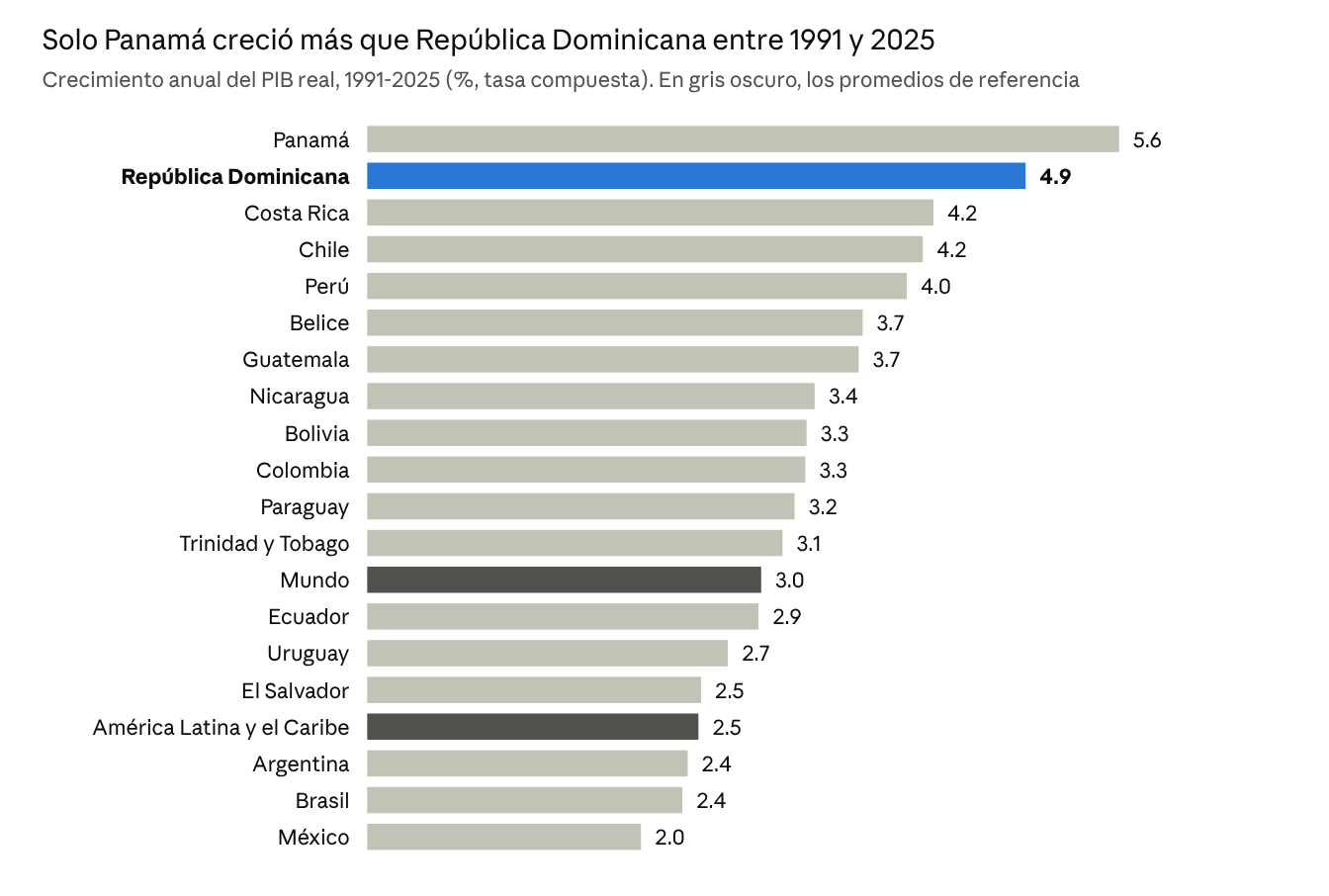
The Dominican Republic grew 4.9 % a year between 1991 and 2025. It was the second fastest-growing economy in Latin America, behind Panama, and the one with the steadiest pace. This report uses public data to check how much it grew, why it grew and what was left pending.
Starting point
On October 7, 2026, at the 41st session of ECLAC (CEPAL), held in Santiago de los Caballeros, its executive secretary, José Manuel Salazar-Xirinachs, said that no country in the region has grown at the pace of the Dominican Republic over 35 years. This report tested that claim against data from the World Bank, the Central Bank of the Dominican Republic (BCRD), ECLAC, the Directorate General of Customs (DGA) and the Public Credit Directorate. The figure is accurate; the exclusivity is not.
Key findings
| Finding | Data |
|---|---|
| The country grew almost 5 % a year for 35 years | 4.9 % a year between 1991 and 2025; the economy multiplied by 5.4 |
| It was not the fastest-growing | Panama grew 5.6 % a year and multiplied its economy by 6.8. Guyana is treated separately because of its oil boom since 2020 |
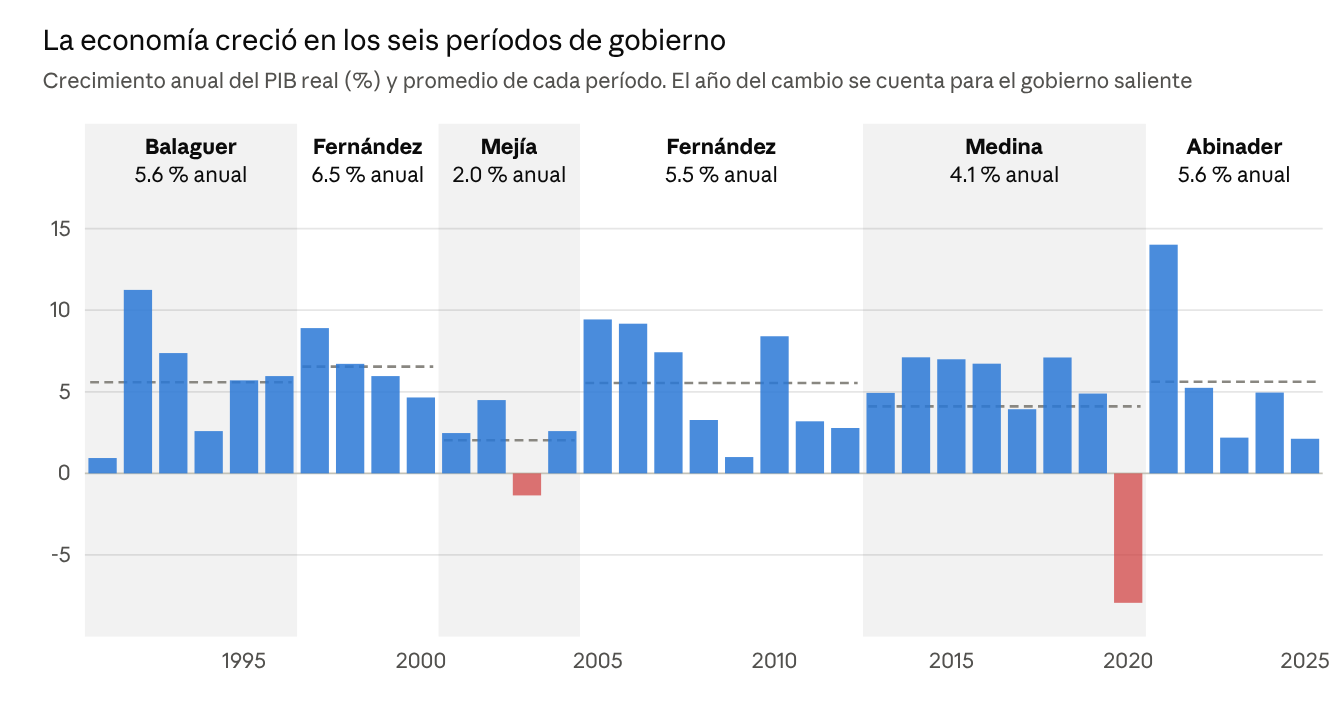
| It had the steadiest pace | In any ten consecutive years it grew at least 3.9 % a year; it only contracted in 2003 and 2020 |
| First in the last decade, per person | 3.2 % a year between 2016 and 2025, compared with 2.3 % for Panama and 0.5 % for the region, excluding Guyana |
| It caught up with the regional average income | Its income per person was 40 % of the regional average in 1990 and 100 % in 2025 |
| It grew under every government | Between 2.0 % and 6.5 % a year in all six government periods; a fiscal deficit in all of them since 2001 |
| It grew by accumulation, not productivity | Of 5.0 points of annual growth between 1991 and 2023, 4.8 came from physical and human capital and 0.2 from productivity |
| It left problems unresolved | 54 % informal employment; electricity losses of 38.8 %; 24 of every 100 pesos of taxes pay interest |
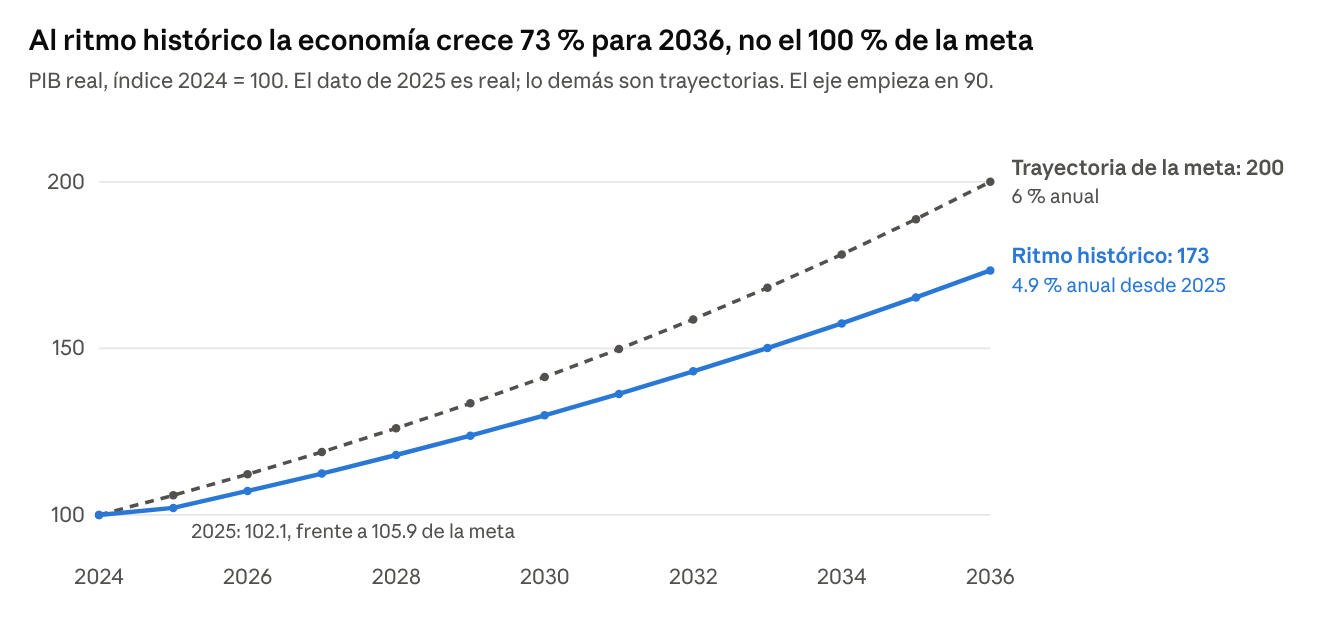
| Doubling the economy by 2036 requires more | The goal requires 6 % a year; at the historical pace of 4.9 %, the economy doubles in 2039 |
Charts from the report
Contents
| Part | Content |
|---|---|
| I. The fact | Overview and verification against the region |
| II. The engines | The reforms of the 1990s, the sectors that grew, investment and trade |
| III. The tests | The 2003 banking crisis, the 2008 crisis, the pandemic and debt |
| IV. Policy | The same indicators for each government period, 1990-2025 |
| V. The neighbor | Haiti: trade, migration and labor |
| VI. The debts | Informality, wages, education, electricity, public debt and taxes |
| VII. The future | Goal RD 2036: what doubling the economy requires |
Data files (CSV, column names in Spanish)
- Indicators by government period, 1991-2025gobiernos_indicadores.csv
- Central government fiscal balance, 1990-2025balance_fiscal_1990_2025.csv
- Interest on public debt and tax revenue, 1990-2025intereses_e_impuestos_1990_2025.csv
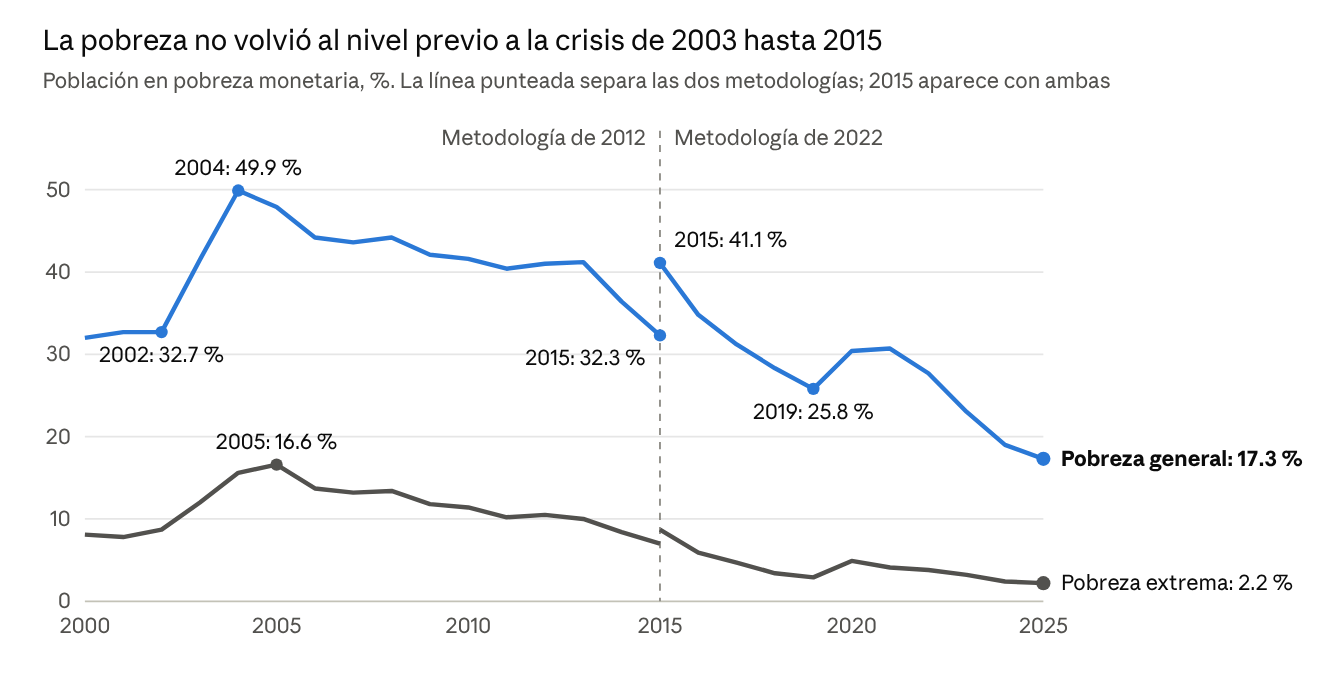
- General and extreme monetary poverty, 2000-2025pobreza_nacional_2000_2025.csv
- Monetary poverty with the 2012 methodology, 2000-2015pobreza_2000_2015_metodologia_2012.csv
- Structural poverty according to the quality-of-life index, 1991-2002pobreza_estructural_1991_2002.csv
- Real GDP per person, Dominican Republic and Haiti, 1990-2025pib_por_persona_rd_haiti_1990_2025.csv
- Exports to Haiti according to the DGA, 2012-2026exportaciones_a_haiti_dga_2012_2026.csv
- Real wage, output per worker and informality, 2015-2025salario_productividad_informalidad_2015_2025.csv
- Central government electricity subsidy, 2000-2025subsidio_electrico_2000_2025.csv
- GDP paths toward the 2036 goalmeta_2036_trayectorias.csv
Corrections
- October 11, 2026: Net international reserves from 2003 onward had been taken from the gross reserves column of the Central Bank file. The chart and text of section 6.2 (a low of 97 million dollars in September 2003, not 279 in December), the end-2005 figure (1,520 million, not 1,929) and the table in section 8.4 were corrected. The report's conclusions do not change.
- October 11, 2026: Average inflation for 2011 had been taken from the World Bank file, which gives 5.8 %. The Central Bank CPI and the IMF give 8.5 %. The chart in section 3.1 and average inflation for 2005-2012 in the table of section 8.2 (6.1 %, not 5.7 %) were corrected. The other years match in both sources and the report's conclusions do not change.
How to cite
Economía con Datos (2026). El caso Dominicano: 35 años de crecimiento económico, 1991-2025 [The Dominican Case: 35 years of economic growth in the Dominican Republic, 1991-2025]. Report no. 1. Santo Domingo. https://economiacondatos.org/informes/el-caso-dominicano/